

Picture this. It’s a Tuesday morning in October, the air is sharp, and a two-person crew is parking a truck in front of a duplex in Laval. They unload extension ladders, harnesses, leaf blowers, a wet-dry vacuum, and a clipboard. Before either of them sets foot on the roof, they spend ten minutes walking the perimeter of the building. They look up. They look down. They look at gutters, downspouts, soffits, the angle of the fascia, the condition of the roof edge. Only then does the work begin.
If you’ve never watched a professional exterior maintenance team do their thing, this might surprise you. Most homeowners imagine the job as “show up, clean, leave.” It’s not.
Read the building first
A good crew treats every building like a puzzle they haven’t seen before, even if they have. Roof slopes change. Trees grow. Caulking ages. The way water moved across this duplex last spring isn’t necessarily the way it moves today. So the first ten minutes are diagnostic, not productive. Nothing visible is happening, but a lot is being noticed.
This kind of attention is what separates a basic cleaning operation from full-service work. The crew documents the building’s condition before touching anything. Partly for accountability. Partly because the inspection itself often reveals issues the homeowner didn’t know existed.
Set up the work zone safely
This sounds boring. It’s actually the most important step of the entire day.
Ladders get positioned at the correct angle (a four-to-one ratio is standard). They’re tied off at the top whenever possible. Harnesses come out for any work near a roof edge. The CNESST publishes detailed safety rules for working at height in Quebec, and a serious crew treats those rules as the floor, not the ceiling. When you hire pros, you’re not just paying for the work itself. You’re paying for the part where nobody falls off your house. That’s where the experience and licensing of teams like cleaning services by Entretien Squidgee, which operates across Laval and the North Shore of Montreal, becomes more than a marketing claim. Safety equipment and trained handling of it are non-negotiable parts of a real service.
Clear the gutters, the right way
This is where most people picture the work happening. And yes, there’s scooping. Lots of it.
But here’s what most homeowners don’t realize. A real cleaning isn’t “remove what you can see.” It’s three layers.
The visible debris comes out first. Leaves, twigs, maple seeds, the occasional bird’s nest. Usually by hand or with a small scoop.
Then the compacted sludge. Underneath the visible layer, there’s almost always a denser layer of decomposed organic matter, often mixed with asphalt granules from the roof. This is what causes most blockages, and it needs to be scraped out carefully without damaging the gutter metal.
Then the flush. Once the solids are gone, the gutter gets rinsed. Water is run from the high end and observed all the way down to the discharge point. If the water doesn’t flow freely, there’s a hidden blockage somewhere, usually in a downspout elbow. That last step is the one amateurs skip. And it’s the one that reveals eighty percent of the real problems.
Inspect what was underneath
Once the gutter is clean, the crew checks what was hidden by the debris.
How are the hangers? Some will be loose, some will have rusted, some will have pulled away from the fascia. How are the joints between sections? Caulking degrades, especially at corners. How is the slope? A gutter that’s pitched slightly wrong will still hold water after a flush, and that water becomes a freeze hazard.
This is also when they check the fascia and soffit. Water damage at the roof edge is sneaky. It can rot wood from the inside while the outside still looks fine. A trained eye catches it early, weeks or months before a homeowner would.
Handle the high-pressure work carefully
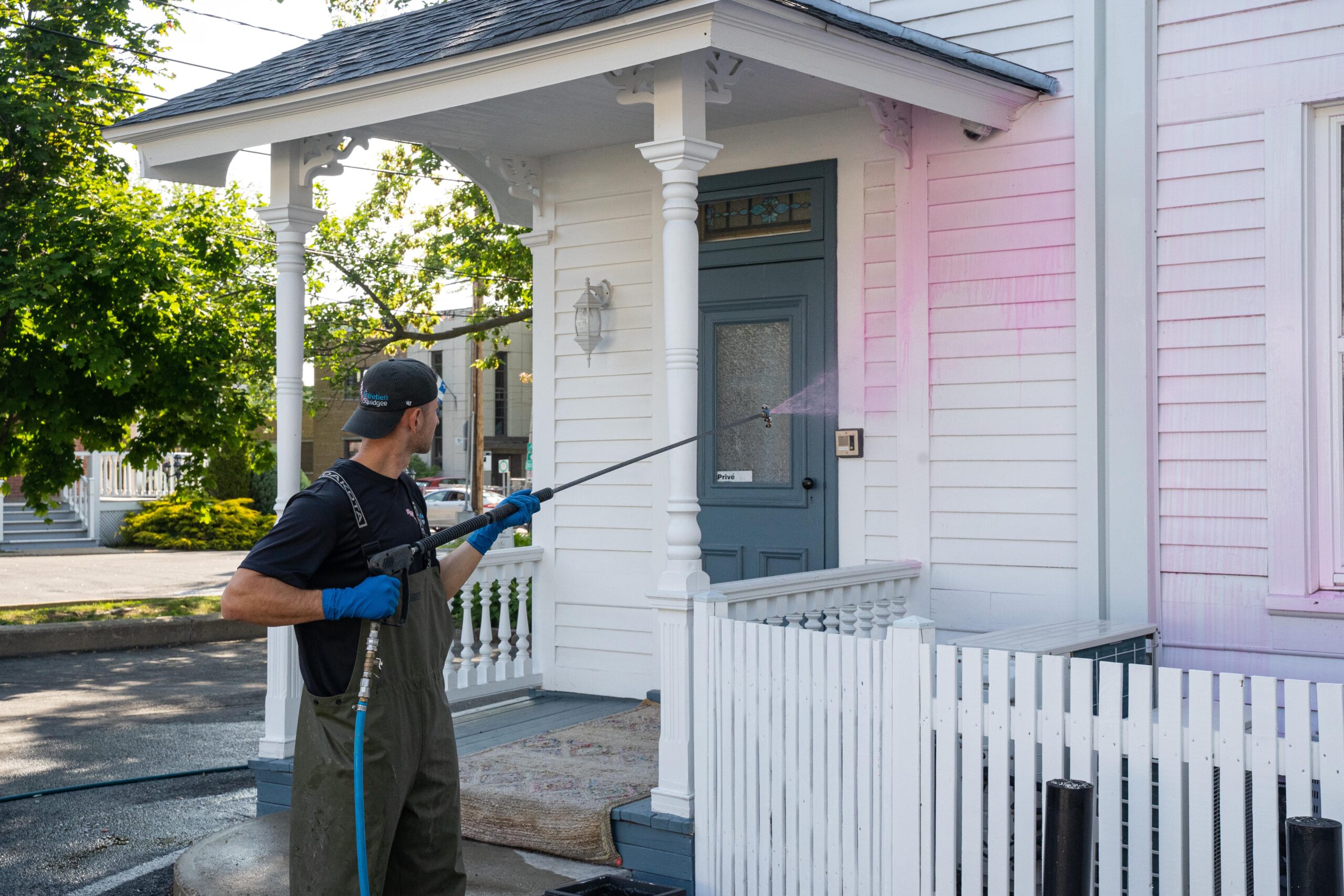
Some visits include exterior cleaning beyond the gutters. Pressure washing the walls, the soffits, the deck, the foundation. This is where technique really matters.
Pressure that’s perfect for concrete will destroy vinyl. Pressure that’s appropriate for brick will gouge wood. A skilled operator adjusts the PSI, the nozzle angle, and the distance to the surface for every material they touch. For more delicate surfaces, soft washing (low pressure plus a biodegradable cleaning solution) does the job without damage.
This is one of those areas where renting a pressure washer and trying to DIY usually creates more problems than it solves. Surfaces get etched. Mortar gets blown out from between bricks. Vinyl siding gets cracked. Pros know the limits of the equipment they’re holding.
Clean up the evidence
Here’s a small thing that says a lot about a crew. After they’re done, does the property look like they were there?
A professional team leaves no trace. The lawn doesn’t have gutter debris scattered across it. The driveway isn’t covered in wet leaves. The garbage is bagged and taken with them, or at minimum, neatly placed where the homeowner asked.
This isn’t optional. A messy cleanup tells you the crew is focused on finishing the job fast, not finishing it right.
Write it all down
The last step happens in the truck, with the clipboard.
A short report. Photos before and after. Notes about anything that needs attention next time. A hanger that should be replaced. A section of caulking that’s starting to fail. A downspout that should probably be redirected away from the foundation. Recommendations for when the next visit should happen, based on what was observed today.
That report is what turns a one-time service into a relationship. The homeowner gets a record of their property’s condition. The next crew that shows up, six months or a year from now, has a baseline to compare against. Problems get caught early because they’re being tracked over time.
Why the boring stuff matters
Watching a professional crew work is, honestly, not very dramatic. There’s no rushing. There’s no shortcuts. There’s a lot of standing around assessing things before any action gets taken.
That’s the point.
The dramatic stuff (water in the basement, ice dams in February, foundation cracks discovered three years too late) happens precisely when boring, methodical exterior maintenance gets skipped. Each step of the process exists because something bad happens when it’s missing. The careful inspection prevents missed problems. The proper safety setup prevents accidents. The full flush prevents hidden blockages. The post-job report prevents loss of institutional memory.
When you watch a good crew, what you’re really watching is twenty different small disciplines, layered together, applied consistently. The result is a building that gets a few more years of useful life out of every component it has, and a homeowner who sleeps better when it rains.
